




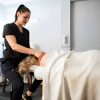

Ladders, hose raises, pike poles, and SCBA straps overload the rotator cuff and stiffen the thoracic spine, forcing shruggy mechanics that pinch the front of the shoulder. Registered Massage Therapy (RMT) down-regulates hot spots (cuff, pec minor, lats, upper traps), opens the mid-back, and re-trains scapular control so Vancouver firefighters can press, carry, and reach overhead without pain.
Already dealing with trap/deltoid overload? See RMT for firefighter in Vancouver or book at RMT East Vancouver (Fraser Street: RMT clinic East Vancouver).

Why ladder and hose lifts beat up shoulders
Task → Tissue stress → Common symptom
Ladder climbs / overhead pulls → supraspinatus, infraspinatus, biceps tendon → painful mid-arc (70–120°)
Hose raises / carries → deltoid (all heads), cuff endurance → outer-shoulder burn, night ache
SCBA & radio straps → upper trap/levator bias → neck tightness, tension headaches
Limited thoracic extension/rotation → compensatory AC joint and anterior shoulder load → “pinchy” front shoulder, rib pop
Add long call durations and poor sleep, and you get a shoulder that moves by shrugging instead of gliding.
Quick self-screen (under 60 seconds)
Painful arc test: Lift arm out to the side. Pain between 70–120°?
Wall angel: Back, elbows, and wrists to wall. Can you keep ribs down and wrists touching? If not, thoracic tightness is likely.
Seated trunk rotation: Arms across chest; rotate right/left. A sticky side that tugs the shoulder suggests thoracic limits driving cuff strain.
Two+ “fails” = high odds of cuff overload with thoracic stiffness.
How RMT restores clean overhead mechanics
Clinic goals: lower pain/tone in overworked tissues, free the chest/lat, unlock thoracic motion, then re-educate scapula + cuff.
1) Targeted soft-tissue work
Rotator cuff: supraspinatus, infraspinatus, teres minor/major, subscap (tolerated depth)
Anterior chain: pec minor/upper pec (unround the shoulder), lat (stop front-shoulder pinch)
Neck/upper quarter: upper trap, levator, scalenes (offload headache/neck)
2) Scapulothoracic glides & cueing
Assist upward rotation and posterior tilt to replace “shrug first” patterns
Balance rhomboid/levator length so the shoulder blade moves, not just the neck
3) Thoracic opening (mid-back)
Soft-tissue along T4–T8 paraspinals + gentle rib springing (as tolerated)
Breathing drills to expand into the posterior ribs (down-regulates trap tone)
4) Neuromuscular re-education
Low-load ER/abduction isometrics to wake the cuff without pain
PNF holds for lower traps and serratus anterior to anchor the shoulder blade
Tempo work: smooth, quiet neck; ribs down
Book firefighter-informed care via RMT for firefighter in Vancouver with our team at RMT East Vancouver or RMT clinic East Vancouver.
4-week plan of care (typical)
Phase 1 — Calm & Reset (Weeks 0–2 | 2×/week)
Goals: pain down, tone down, ROM to ~120° without pinch; easier sleep
Methods: targeted release (pec/lat/upper trap/cuff), thoracic opener, gentle scap glides
Phase 2 — Control & Capacity (Weeks 2–5 | 1×/week)
Goals: full overhead without shrug; carries without shoulder hike
Methods: cuff isometrics → light isotonic; serratus/lower-trap control; scaption patterning
Phase 3 — Maintain & Prevent (ongoing | q3–4 weeks or around training)
Goals: keep tissue quality high during busy blocks; quick resets post-incident
Methods: tune-ups + progress home strength

Your 8–10 minute station routine
1) Thoracic extension (towel/foam) — 2 levels × 6 slow breaths
Keep ribs heavy; breathe into mid-back.
2) Doorway pec stretch (low → mid angle) — 2×30s/side
Stretch across chest, not front shoulder.
3) Lat opener (bench “prayer” stretch) — 2×30s
Neutral spine; thumbs up to bias ER.
4) Serratus wall slide + reach — 2×8
Slide, then reach slightly at top; no shrug.
5) Side-lying external rotation (very light) — 2×12/arm
Elbow on towel roll; smooth tempo.
6) Isometric lateral raise hold (pain-free range) — 3×20–30s
Shoulder blades “down & wide”; stop before any pinch.
Pre-shift primer (60–90s): 10 band scap pulls, 10 wall slides, 10 open-book rotations/side.
Post-call cooldown (60–90s): doorway pec, gentle upper-trap/levator stretch, box breathing (in 4, hold 2, out 6).
Hose & ladder ergonomics that save shoulders
Re-seat straps every 20–30 minutes on long calls to rotate pressure points.
Lead with the sternum on climbs (keeps thoracic extension and scapular glide).
Alternate carry sides when safe; micro-breaks beat marathons.
Cue: “Ribs down, neck long, reach from the shoulder blade.”
Tool height: Store frequently used tools between mid-thigh and chest to avoid repeated high shrugs.
When to loop in your MD/physio (red flags)
Night pain that won’t ease in 7–10 days, or sudden loss of overhead strength
Traumatic pop + persistent weakness; suspected rotator cuff tear or labral injury
Progressive numbness/tingling, grip loss, dropping tools
History of dislocation, fracture, or systemic inflammatory condition
RMT is conservative care; we’ll coordinate with your physician/physio when imaging or alternate loading is indicated.
Why firefighters choose Loong Wellness (Vancouver)
Tactical-job experience: We routinely treat firefighters, police, and nurses; protocols match real shift demands.
Registered, insured RMTs with advanced shoulder/headache training.
Shift-friendly scheduling & direct billing to most extended plans.
Two convenient options: book RMT East Vancouver or RMT clinic East Vancouver.
FAQs — RMT for Rotator Cuff & Thoracic Mobility (Firefighters)
How fast will I feel better?
Many feel a lighter shoulder after session 1. Stable overhead comfort typically builds across 3–4 sessions plus the home routine.
Do I need deep tissue?
Not by default. Over-guarded shoulders respond best to slow, specific work + motor control—not maximal pressure.
Can I train after RMT?
Yes—favor mobility/technique the same day. Save heavy overhead lifting for 24 hours later.
Is it covered by benefits?
Most BC extended plans cover RMT. We offer direct billing where available.
Bottom line
Ladder and hose lifts don’t have to cost your shoulders. With firefighter-specific RMT + a 10-minute station routine + a few strap and posture tweaks, you can restore cuff strength, unlock thoracic mobility, and ditch the post-call pinch. Ready to move better overhead? Book at RMT East Vancouver or our RMT clinic East Vancouver, and explore more strategies on RMT for firefighter in Vancouver.

 English
 Chinese